Log injections and vial supply with PeptIQ, utilize peptiq.io calculators for online calculations, and maintain organized protocols. No one can determine the frequency of side effects since the blend has not been studied in humans. Every order is packaged to a higher standard, from secure shipping materials to protective peptide storage cases and premium presentation. Retaining batch history is crucial as it allows laboratories to trace materials obtained months prior instead of only the current lot. Before making a decision on research procurement — examine the current product listing for composition, availability, and supporting documentation.
The following information reflects community practices and research protocols, not a personal endorsement, and does not include approved dosages.

Most people use vial form for systemic effects. The persistent pain that had disturbed my sleep at night disappeared within three weeks. Results are achieved with a properly verified research compound. Improved vascular supply and connective tissue structure are provided by BPC-157 and TB-500.
These uncertainties are particularly relevant when laboratory compounds are discussed online as though they were established therapies. Each component has its own pharmacology — experimental evidence, and potential risks. For people researching KLOW peptide Canada, the regulatory distinction is important.
Klow vs. Glow: What’s the Real Difference?
The compound itself has specific quality requirements, and the gap between a verified vial and a degraded one is bigger than most buyers realize. Searching « where to buy KLOW » returns a wide range of vendors, from established research peptide suppliers to fly-by-night shops with no documentation. It focuses on measured repair and inflammatory outcomes, including mixed findings and results from related thymosin molecules. Both used full-length thymosin beta-4 — so their results should remain separate from claims about a shorter TB-500 fragment or the complete KLOW blend. This gives the hair-growth discussion an experimental basis, although it was not a human hair-loss trial and did not test KLOW. Park’s 2016 study gave mice GHK-Cu before an experimental inflammatory challenge.
Some suppliers use full-length thymosin beta-4 (43 amino acids long), instead of the fragment, which is why the mass on the COA matters. This guide covers what’s in a KLOW vial, what the research on each component actually shows, why the blend is far more lopsided than its name suggests, how it compares with GLOW, and how to verify a blend before it goes into a study. By entering you confirm you are a qualified buyer of research materials and agree to our Terms and Research-Use Policy.
The pace of discovery is relentless, and staying ahead requires not only brilliant minds but also access to the highest quality tools. This approach (which we’ve refined over years) delivers real results in the form of reproducible and trustworthy research outcomes. When investigating something as intricate as how does KLOW work (the purity and consistency of your research material are), quite frankly, paramount.
BPC-157 is investigated in experimental tissue-repair and angiogenesis models. It represents the C-terminal portion of alpha-melanocyte-stimulating hormone — commonly known as α-MSH. Its presence in KLOW is therefore based primarily on interest in these experimental tissue-repair pathways. Because a standard 80 mg KLOW formulation contains around 50 mg of GHK-Cu, it makes up the majority of the blend by mass. , klowresearch.com, They are not intended for human consumption, and are not intended to diagnose, treat, cure, or prevent any disease. Always consult a qualified healthcare provider before considering any new compound or protocol.
The Purity Imperative: Why Quality Matters for KLOW Research

KLOW is used to support the body’s recovery and repair processes, with an added anti-inflammatory and gut-oriented component contributed by KPV. It covers why, as with any injected peptide — the source matters as much as the molecule. We specialize in analyzing clinical trials (peer-reviewed medical literature), and emerging data on peptide therapies. The common KLOW 80 vial contains 50 mg GHK-Cu and 10 mg each of the other three. Anyone evaluating peptide research materials should treat purity and third-party testing as the primary safety factors, since unverified or contaminated material is a larger practical risk than the peptides themselves. As with the other components — these are findings in cultured cells and animal models rather than approved human results.
If you are specifically looking for anti-inflammatory support in addition to repair and regeneration, Klow is the logical choice. It is also completely separate from the question of what amount (if any), is appropriate for a person, which only a qualified healthcare professional can answer. The figures below are simply what the research literature reports for each individual peptide, shared for educational context only. For skin-focused results, see also collagen peptides before and after.
This kind of naming pattern is common in the research peptide space. That’s because ‘klow’ is not a recognized pharmaceutical name, an INN , International Nonproprietary Name,, or a compound with its own peer-reviewed literature. That is precisely why prescribing and sourcing it through a licensed pharmacy (under a physician), matters.
KLOW peptide benefits have become a popular search topic among people exploring newer options in regenerative wellness. Consult a qualified healthcare provider before beginning any protocol. The difference between that and mystery powder matters more than the price difference ever will. If you’re dealing with chronic injuries, gut issues, joint problems, or tissue damage that hasn’t responded to standard treatment, KLOW is worth exploring with proper medical oversight. When you’ve exhausted conventional options and you’re stuck with an injury that isn’t healing, KLOW offers a research-backed approach that addresses multiple mechanisms at once. At the standard 10-unit daily draw a vial lasts 20 days, so on the sale that’s roughly $3.57 a day, versus about $4.95 a day buying the four peptides separately at the same discount.
In laboratory settings, these gaps serve more as experimental variables compared to definitive answers. Four separate stability profiles (distinct molecules), and literatures are compressed into one vial in the blend format, making the underlying science no simpler despite the packaging. KLOW benefits researchers who read the certificate prior to the marketing text. It does not circumvent experimental design — and any supplier suggesting otherwise offers a narrative rather than a genuine compound. The blend format is utilized for convenience in stocking and selling, not due to the characterization of the combination in published literature. A single vial containing four molecules results in four degradation curves (four identity tests), and an inability to connect any result to a specific component.
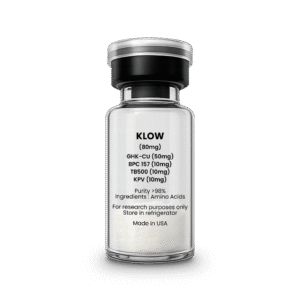
The difference in pharmacokinetics — with BPC-157’s 30-minute half-life contrasting with the 2-4 hour ranges of the other three components, adds a complexity that protocols must consider and has yet to be formally defined. No published research has evaluated KLOW as a whole in comparison to its individual components or its three-component predecessor, GLOW. Controlled studies have yet to establish whether this specific ratio is optimal for any application, as it is a design choice based on dosage ranges of individual components. In comparison to BPC-157 (TB-500), and KPV, GHK-Cu protocols generally utilize higher absolute doses. By weight, GHK-Cu comprises 62.5% of the KLOW vial , 50 mg out of a total of 80 mg,, while the other three components consist of 10 mg each. This allows oral delivery to be feasible for protocols that specifically target gastrointestinal applications using these two components.

Comments are closed